
Some of the athletes I coach run companies. The ones who improve most share one habit. They have the same 24 hours as everyone else, but they organise them into blocks.
These are people who are very good at turning a plan into a result. In endurance sport, though, the plan is only part of the outcome. The rest depends on everything around it: sleep, meals, recovery, and consistency over months. Those are the first things to give way when a calendar fills up.
A real example
One of my athletes founded a company. The business was doing well, and so was his training. Then a second business opportunity appeared and he threw himself into it completely. The days got longer. Time with friends and family got shorter.
As his coach, the first thing I noticed was his character. He became short with the people around him, at home and in his replies. He went quiet. A message could take three days to get an answer.
Five months later he was heavier and slower, yet he still expected to hold his old paces in the water, on the climbs and on the run. His body was no longer keeping up with his expectations. Frustration turned into fatigue, and he went to his doctor for blood tests.
A harder training plan would have made things worse. What he needed was a different structure for his days.
The solution: five blocks a day
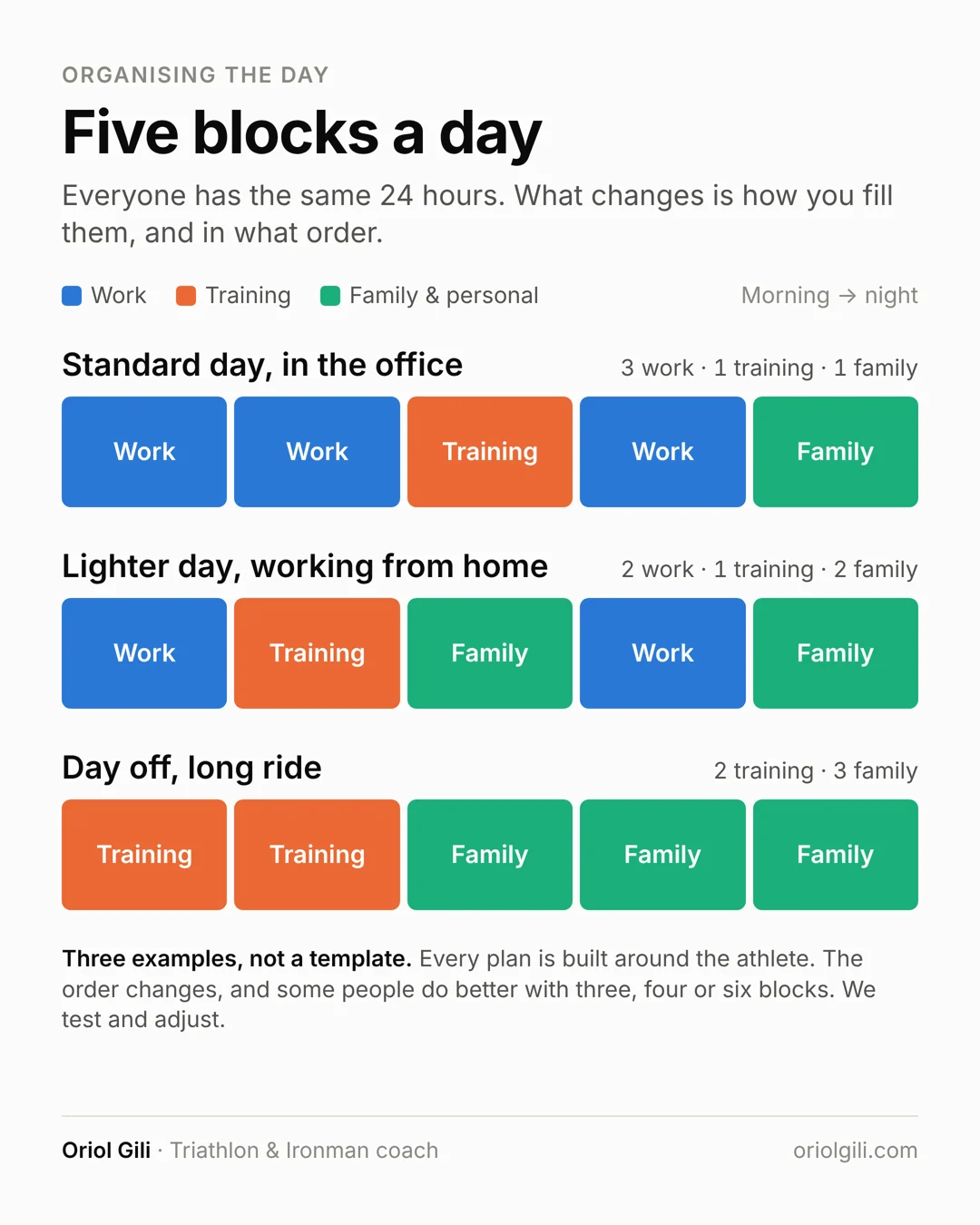
He took a weekend away to think it over. When he came back, I proposed a simple strategy: divide each day into five blocks. A block is a stretch of the day with a single purpose: work, training, or family and personal time.
On a standard day in the office, three blocks go to work, one to training and one to family. On a lighter day working from home it is two, one and two. On a day off with a long ride, two go to training and three to family. The order changes with the day.
The rule does not change: when a block ends, it ends. It works like a meeting with a time limit. Give it ten minutes, and ten minutes turns out to be enough. He found that harder than any interval session, and it is what brought his stress down.
Five blocks is what works for him. Other athletes do better with three, four or six. Every plan is built around the person, and we test and adjust.
The second change: mealtimes
When you eat sets when you digest, and that sets how well you sleep and recover.
He kept a typical Spanish schedule: breakfast at 6:00, lunch at 14:00, training late, family dinner at 22:00, asleep around midnight. Six hours of sleep.
He moved lunch to 12:00 and dinner to 19:00. Now he trains before dinner, eats with his family, and still has time to read and wind down. In bed at 21:30, asleep by 22:00. Eight hours of sleep.
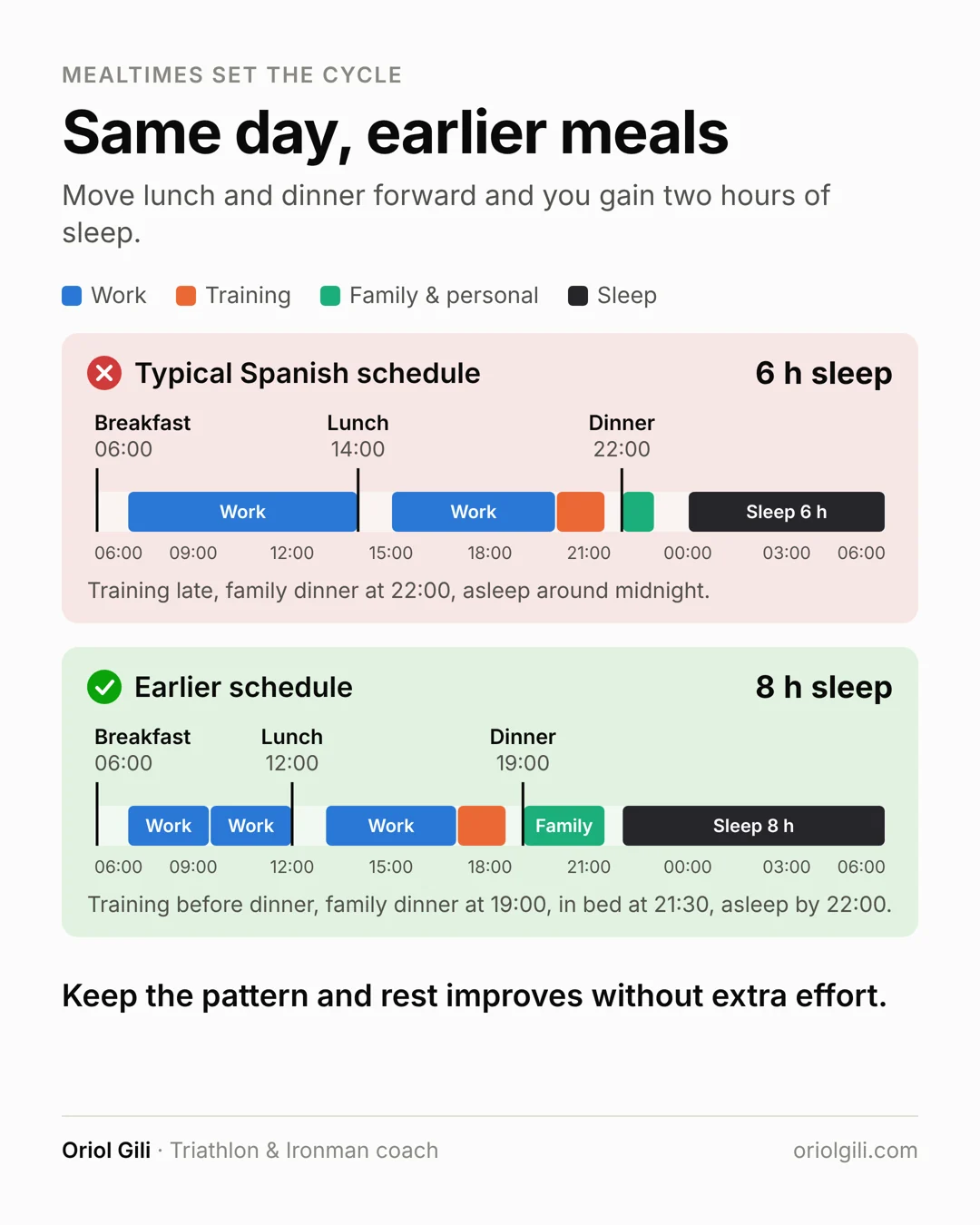
He expected it to be unworkable. Months later, he has not gone back. Keep the pattern and rest improves without extra effort.
What I ask of myself as a coach
I hold myself to the same standard. If a session keeps failing at 21:00, the schedule is wrong, and changing it is my job. If 6:00 is the only hour a parent has, we build the plan around that hour.
What nobody can reorganise is the work itself. Data shows us where to improve. Someone still has to swim, ride and run.
The result
Today he trains better than he did before. His ambition is the same. His days have clearer boundaries now.
How do you organise your 24 hours? If you want help building a plan around your real week, get in touch.