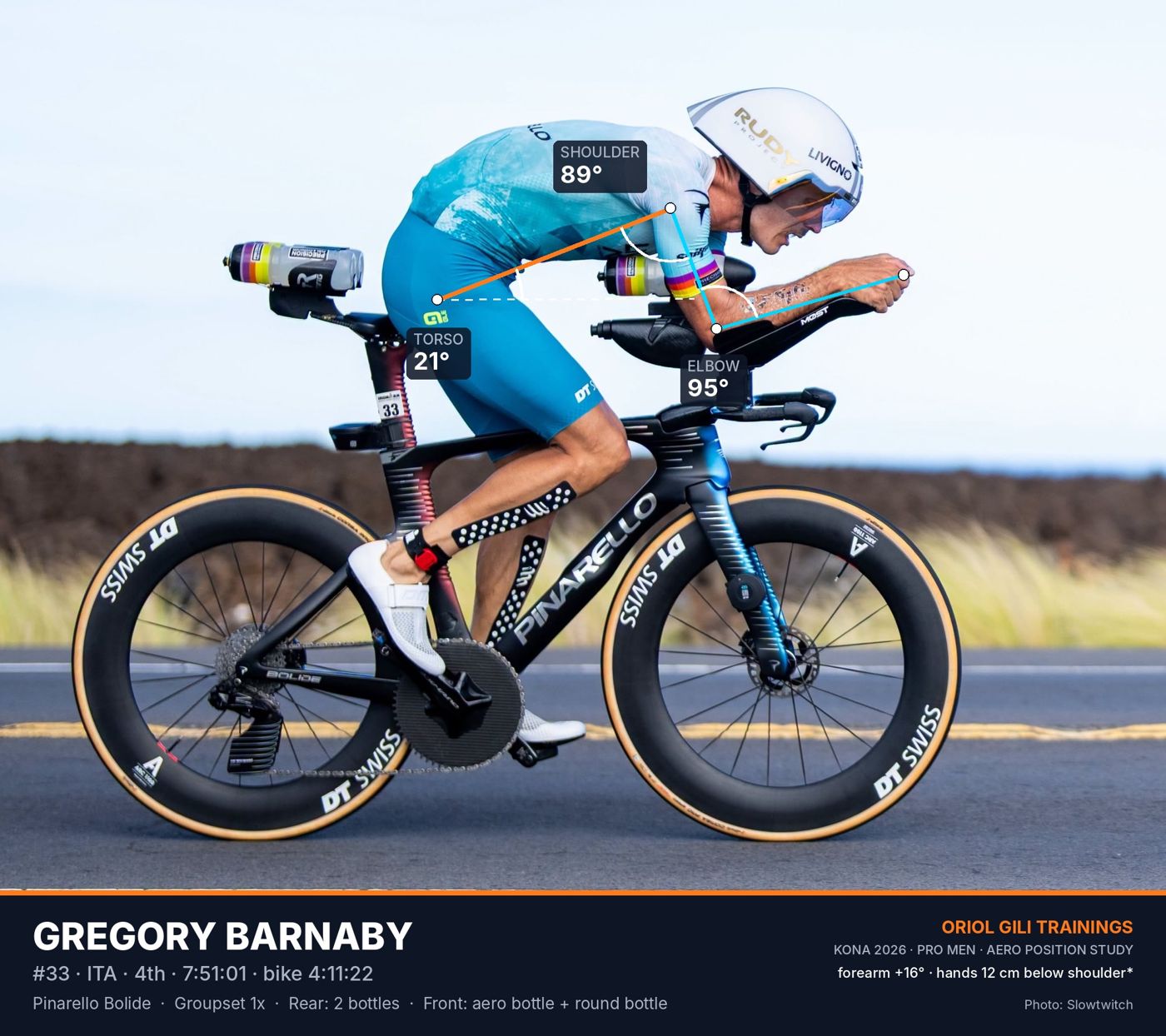
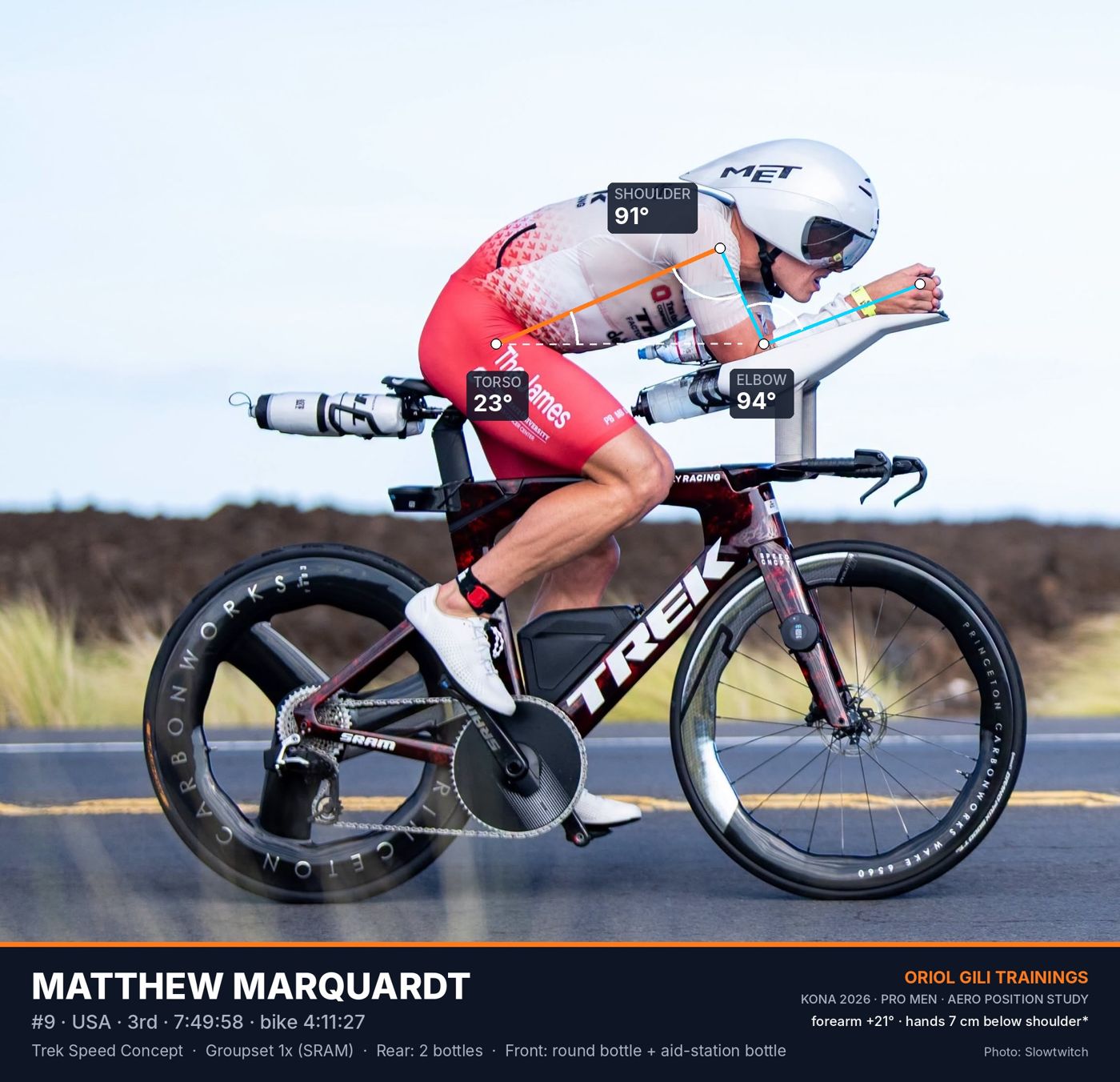
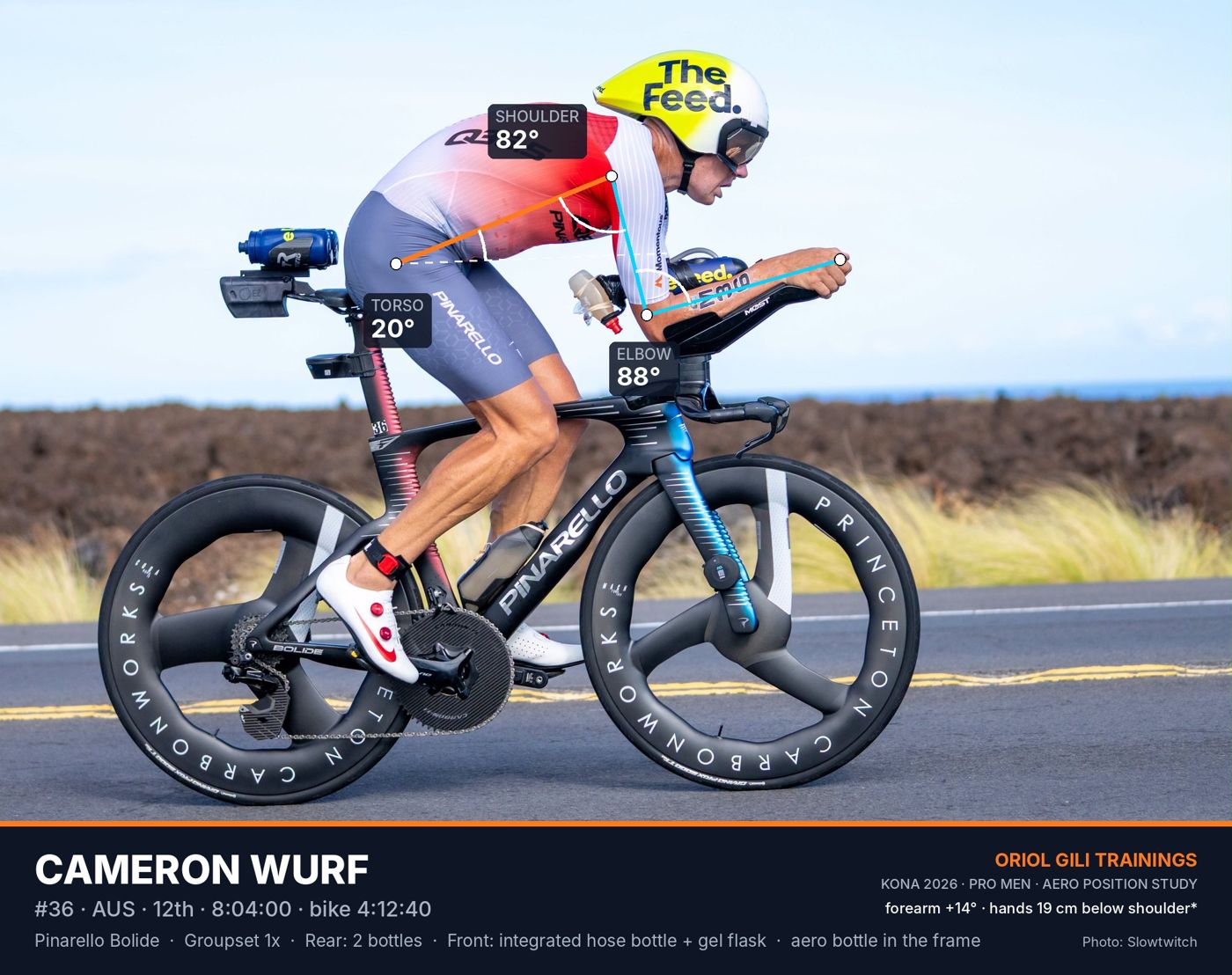
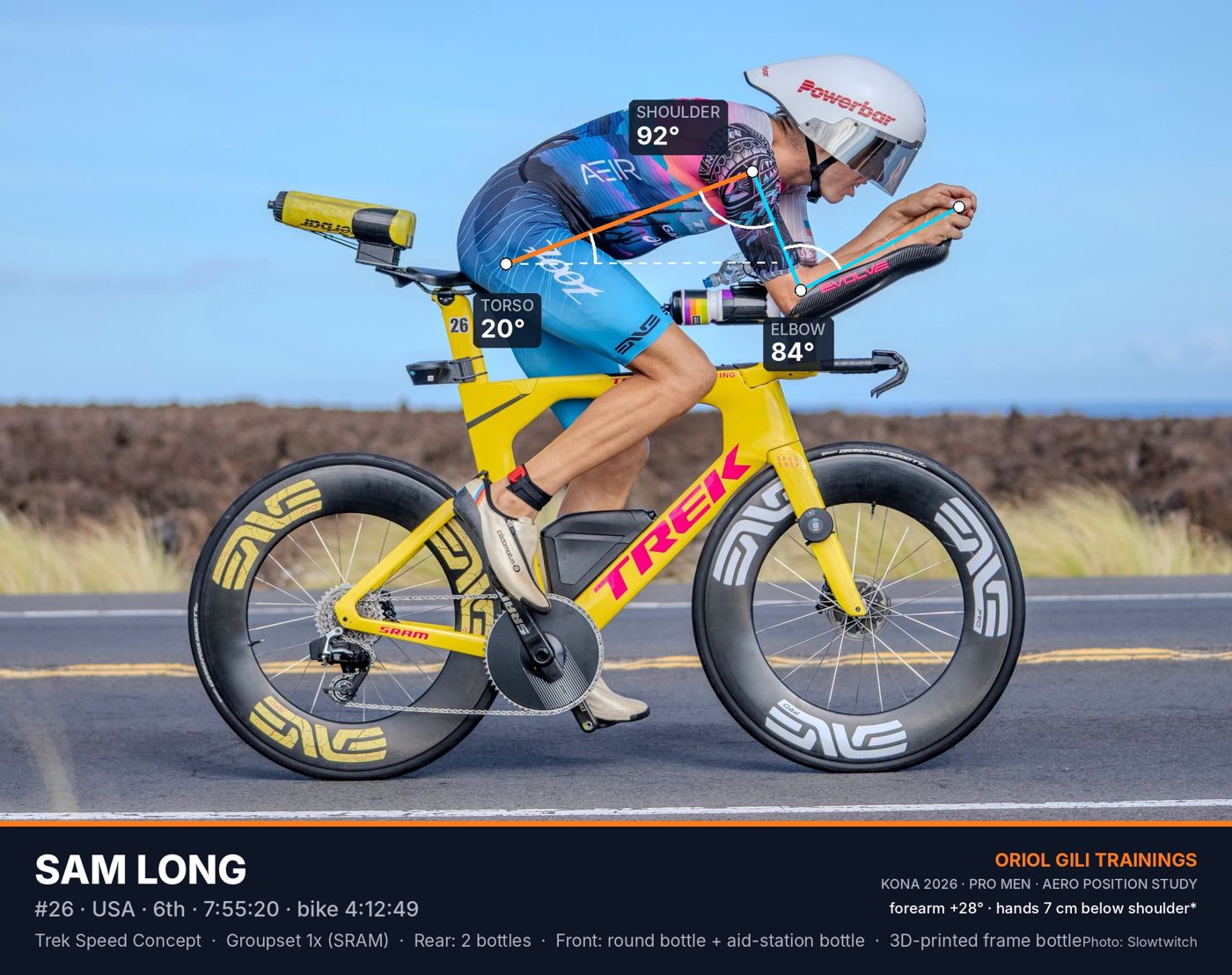
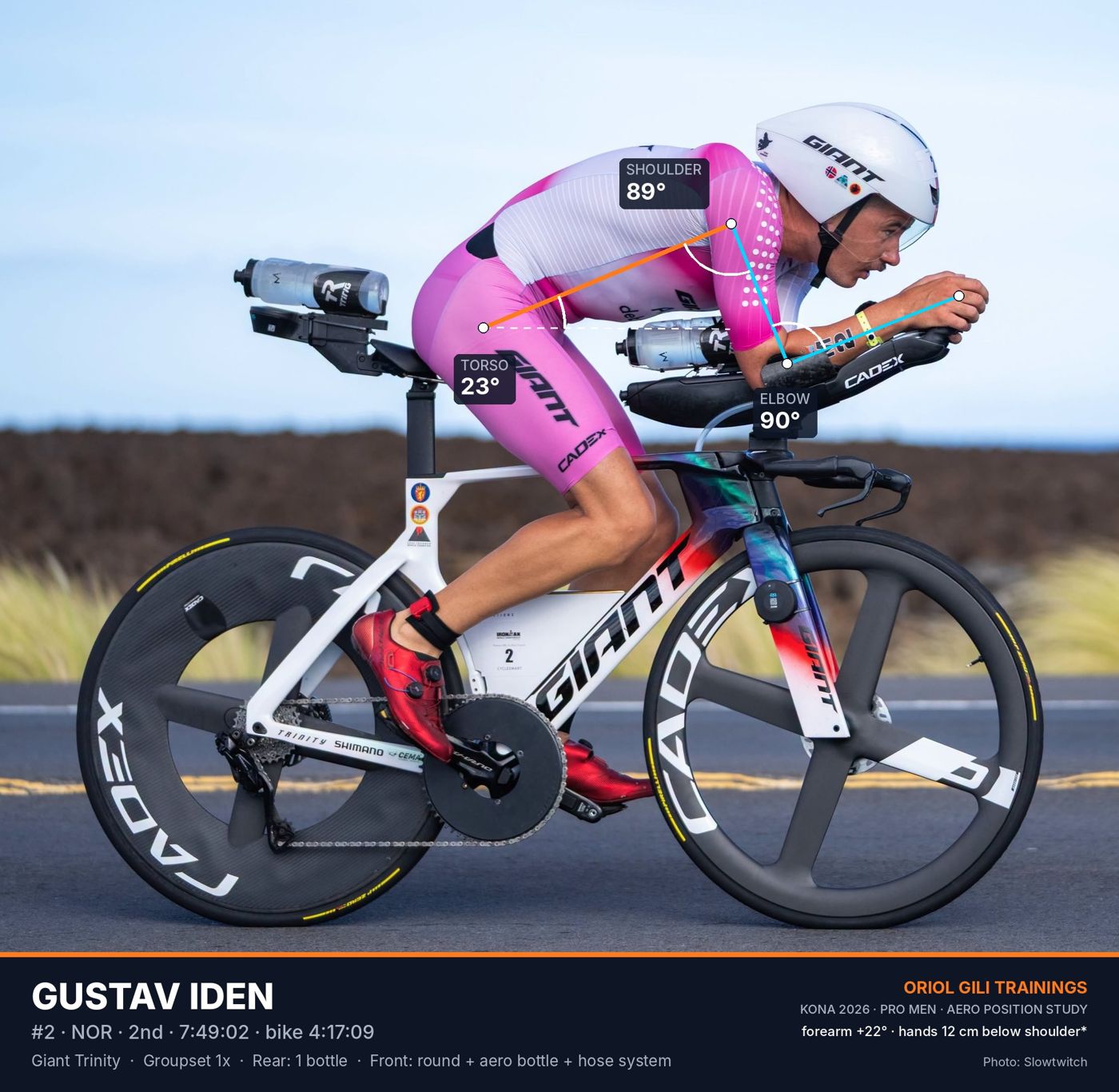
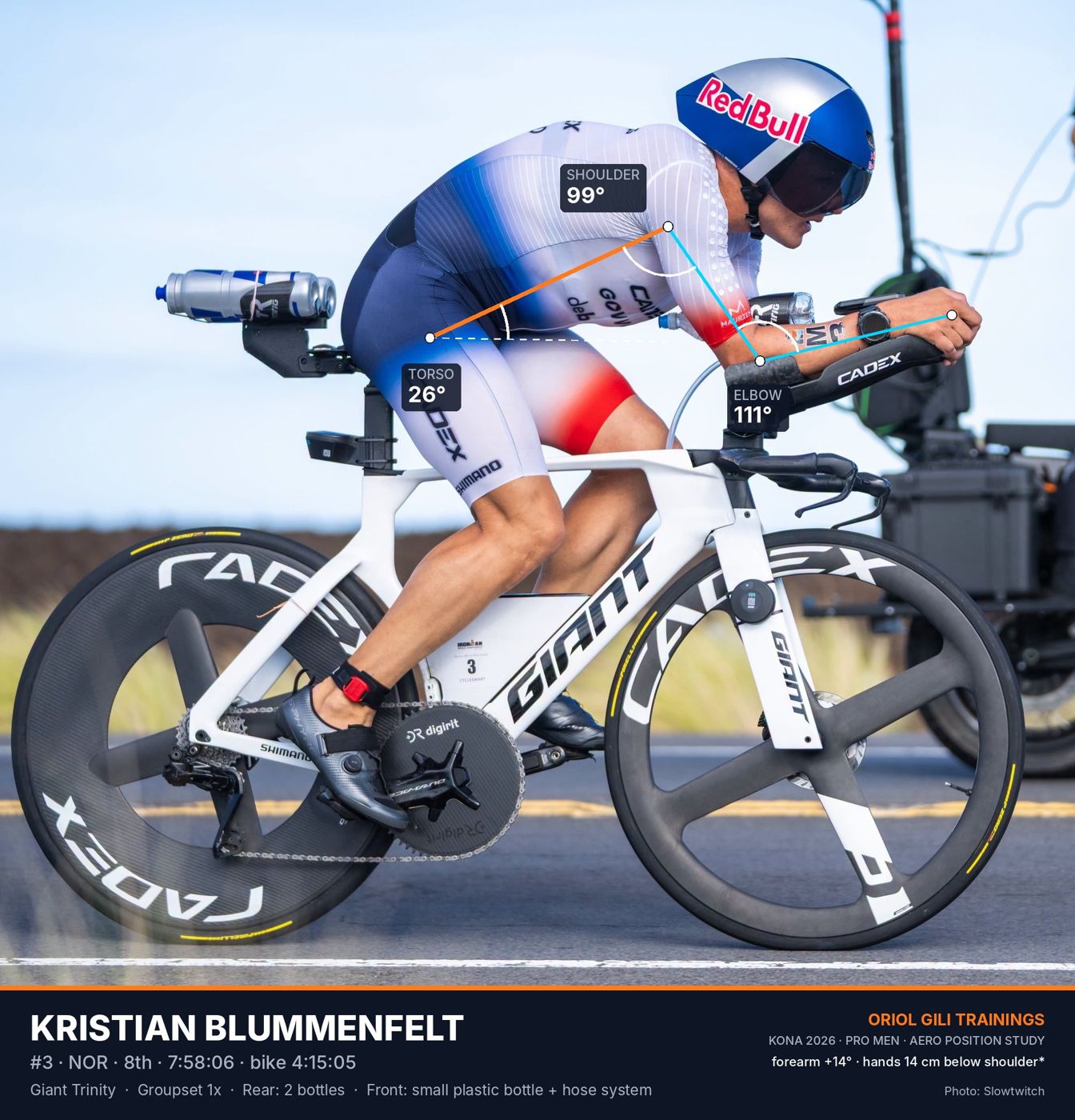
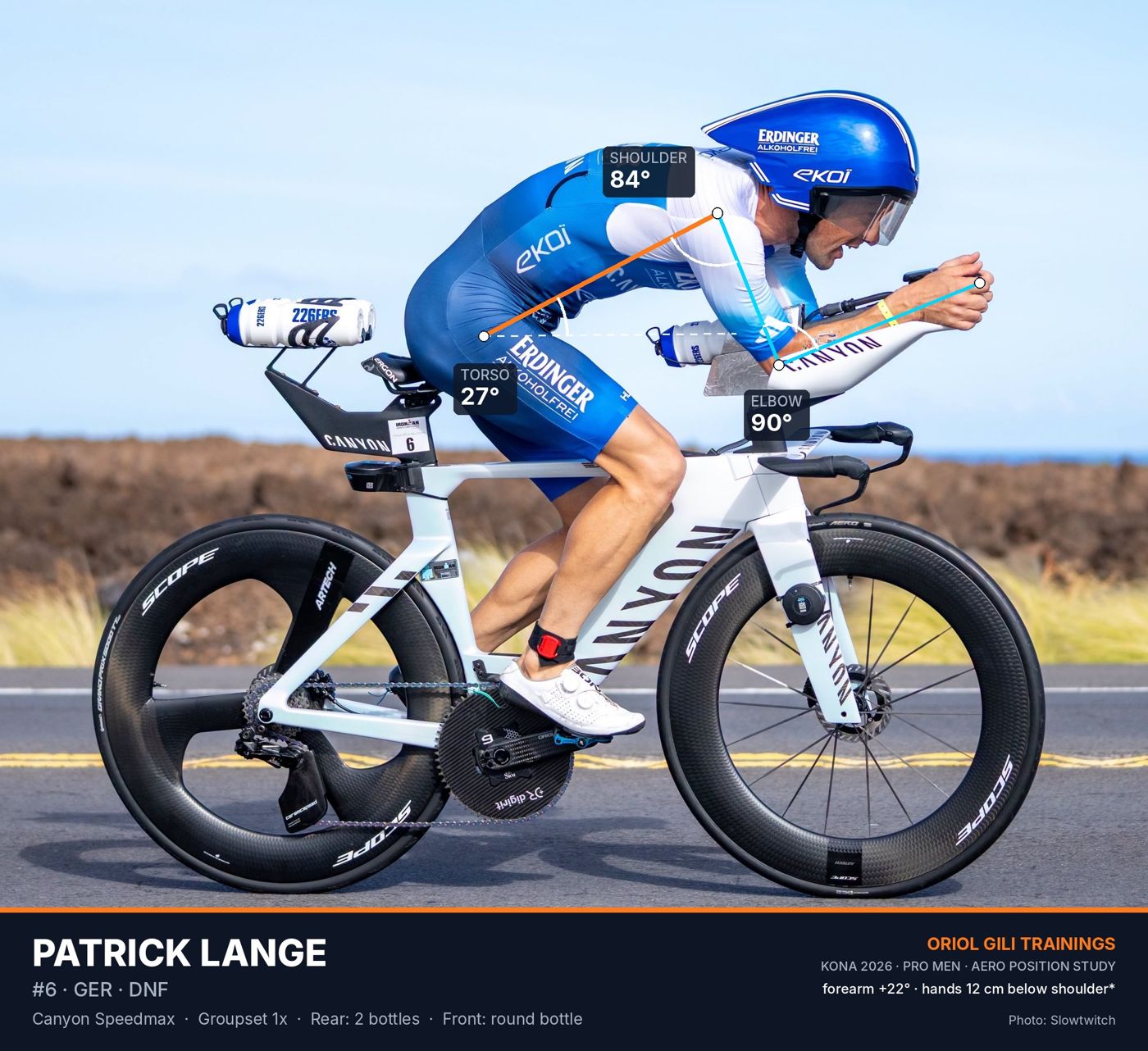
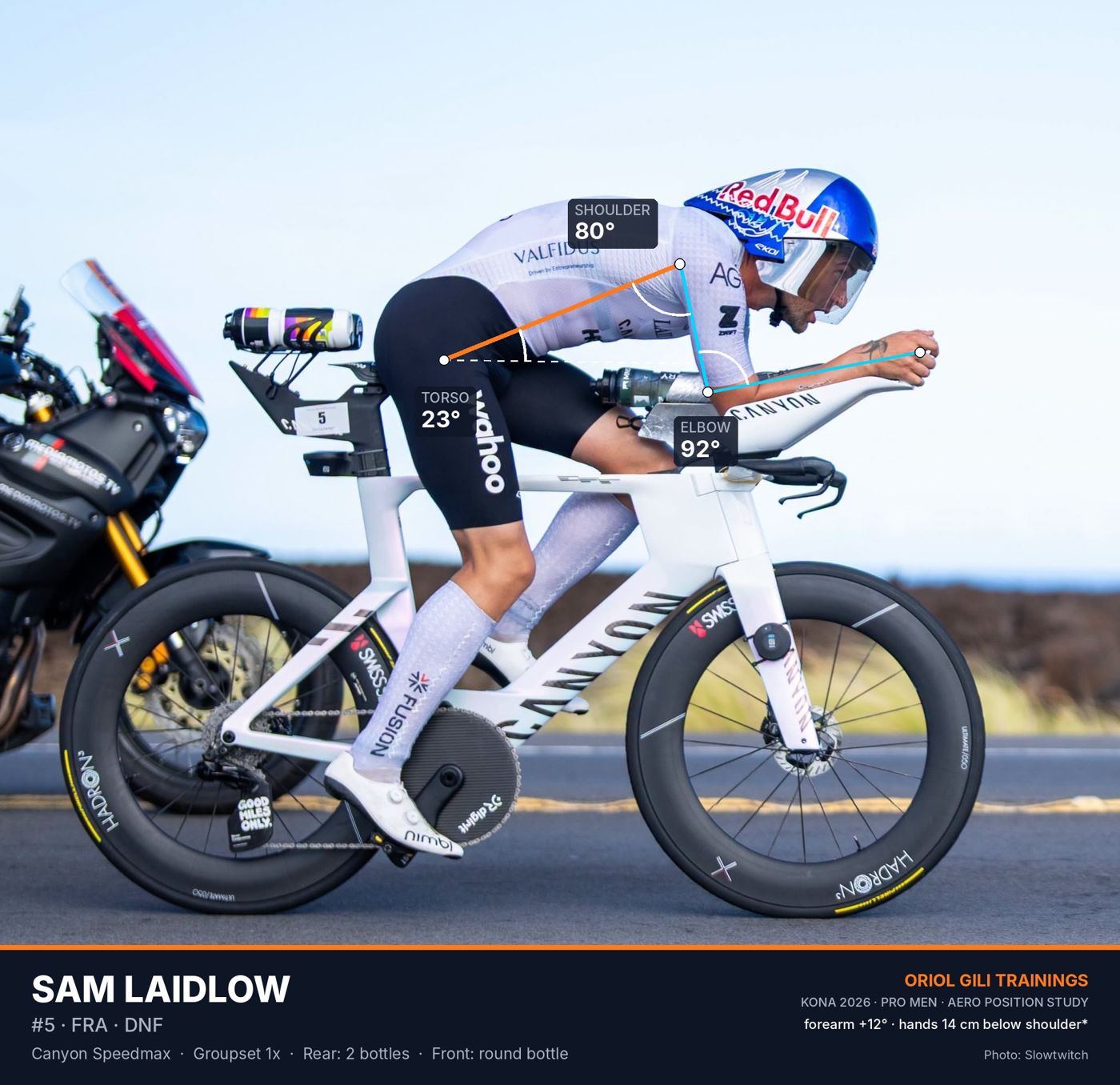
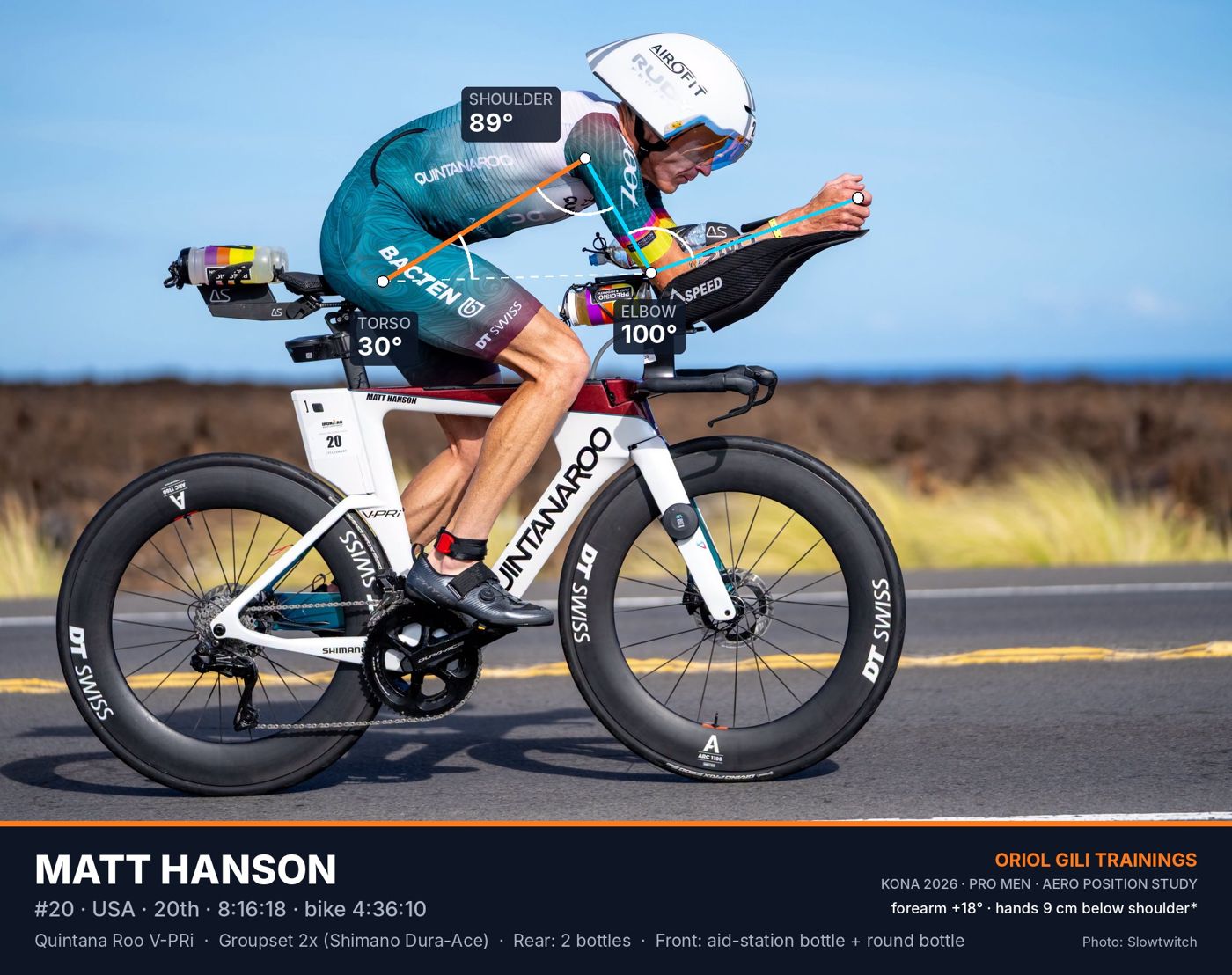
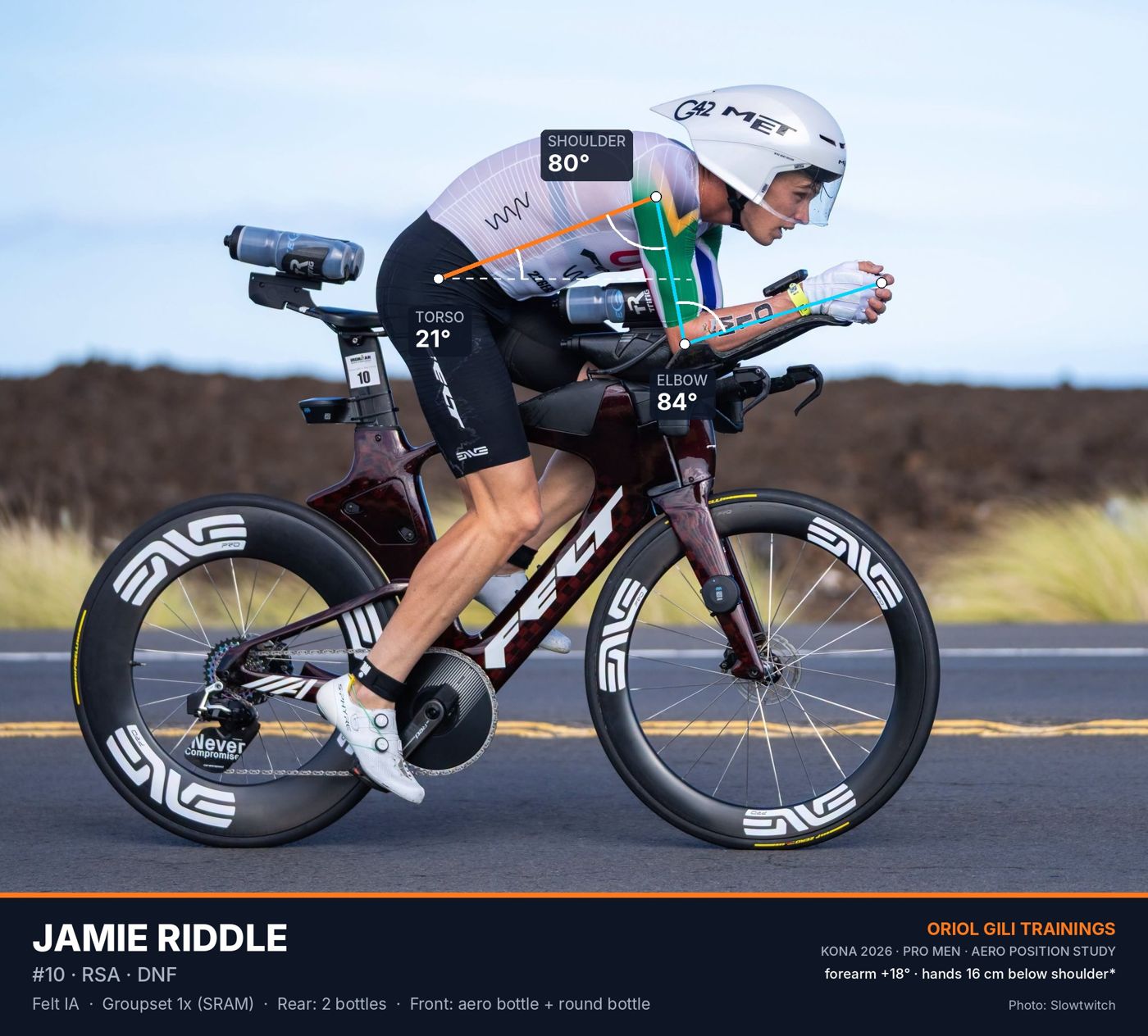
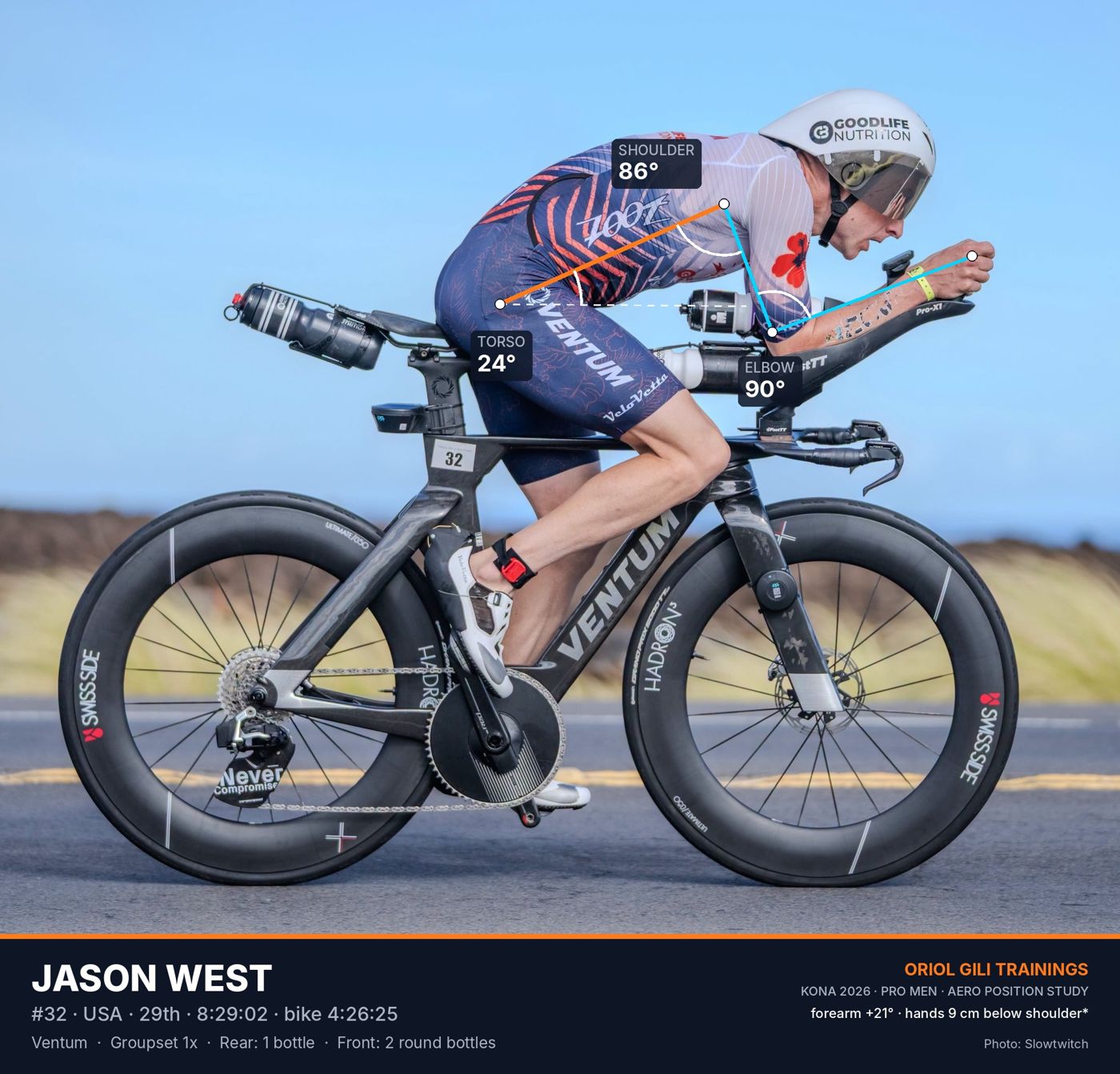
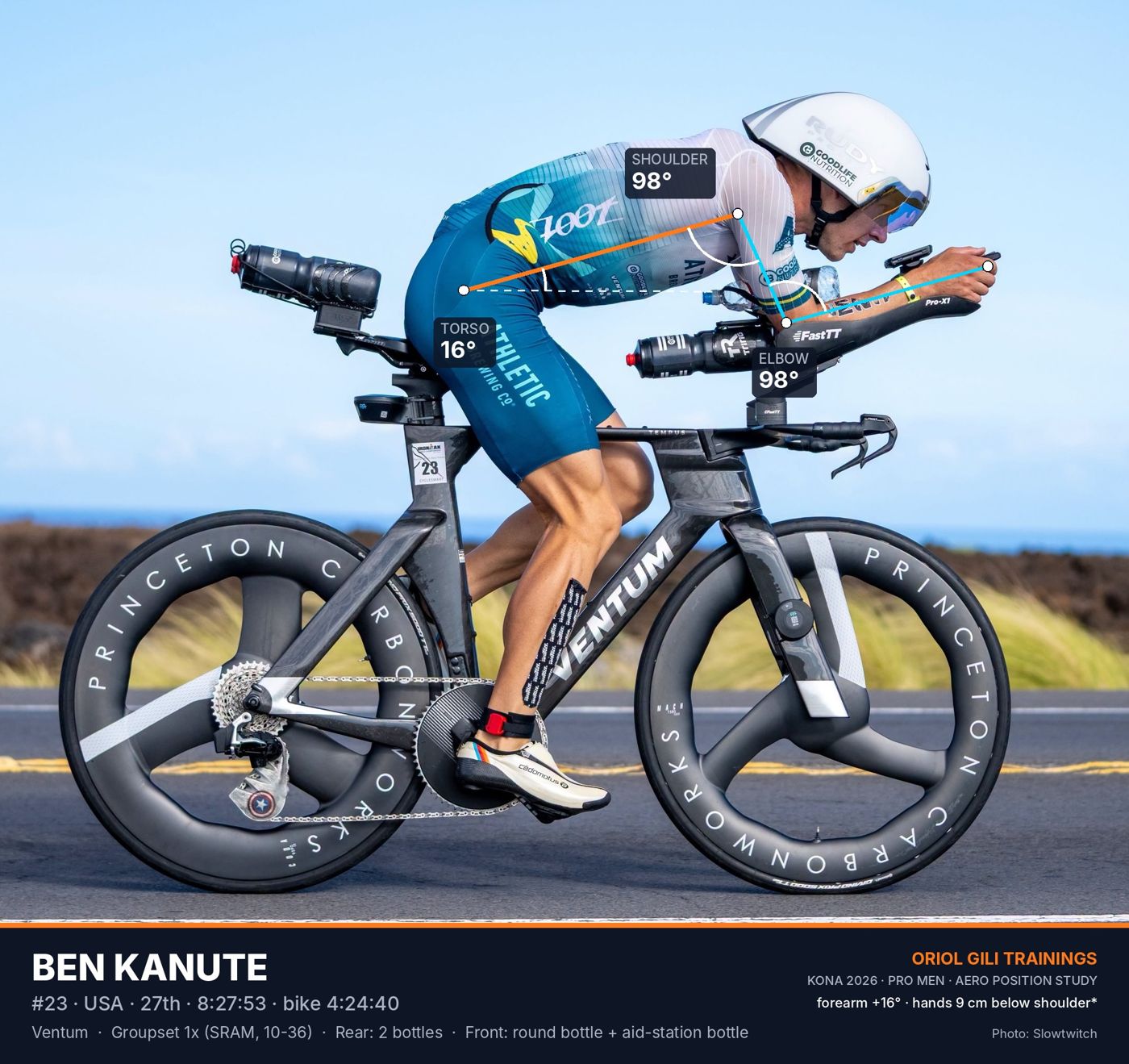
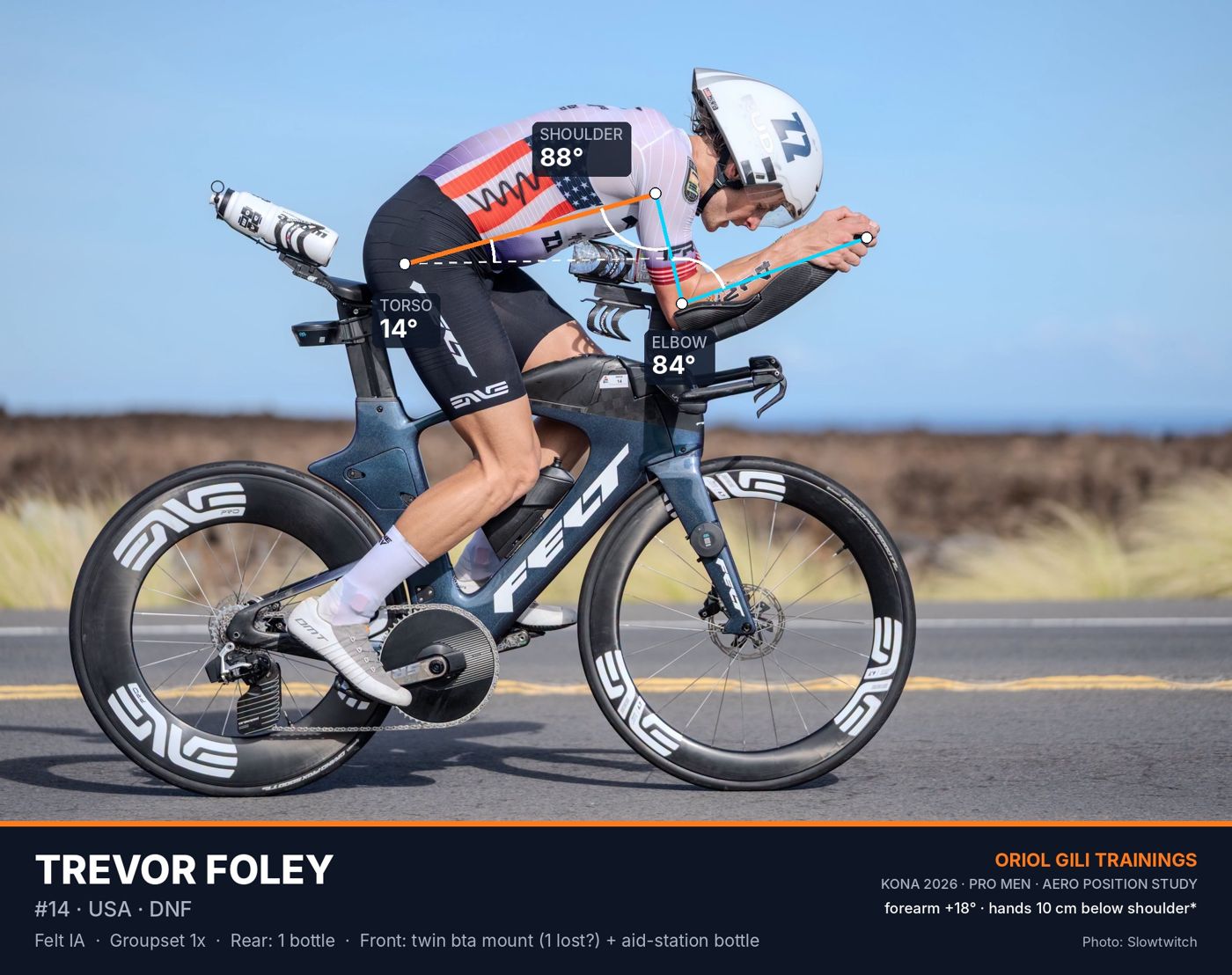
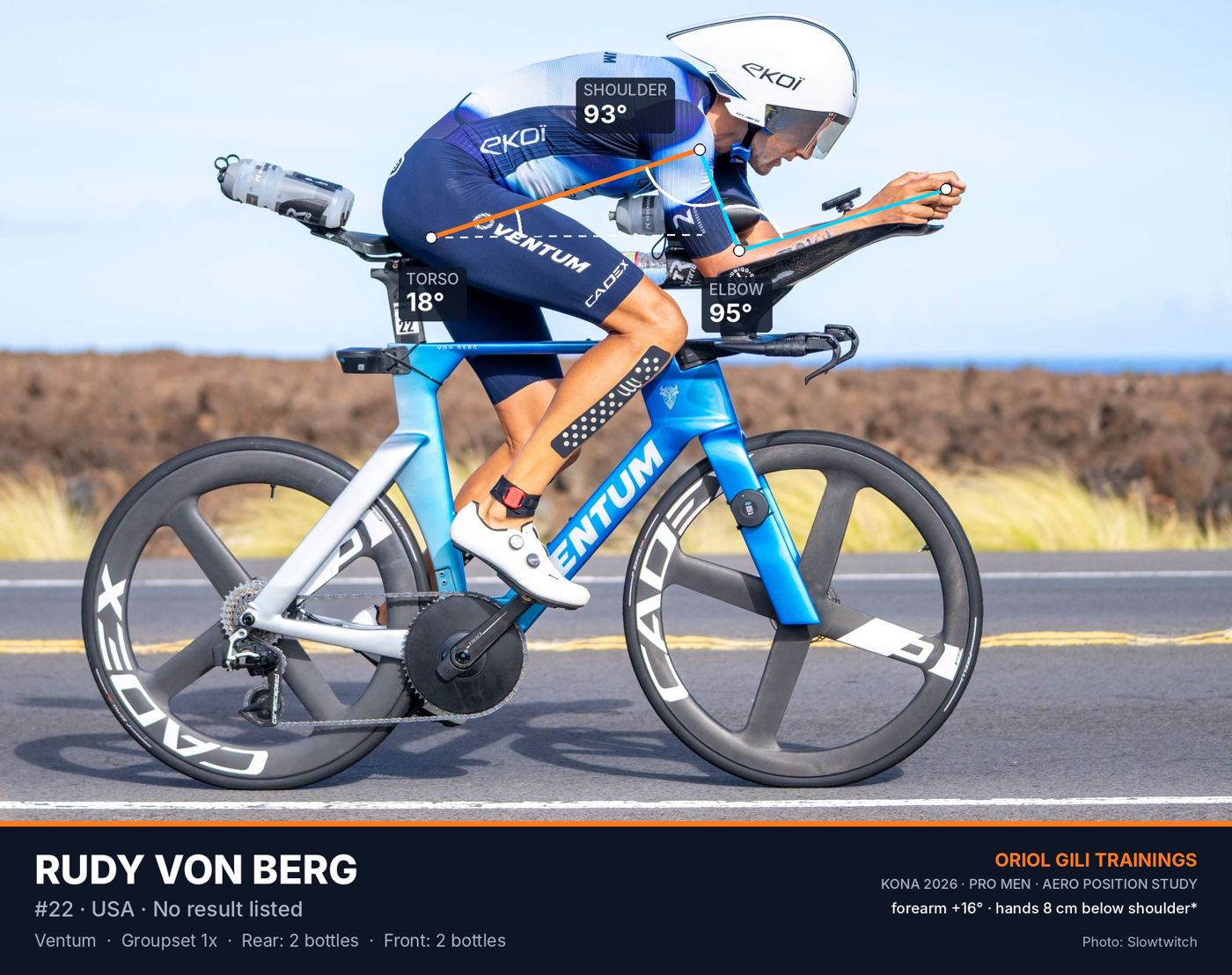
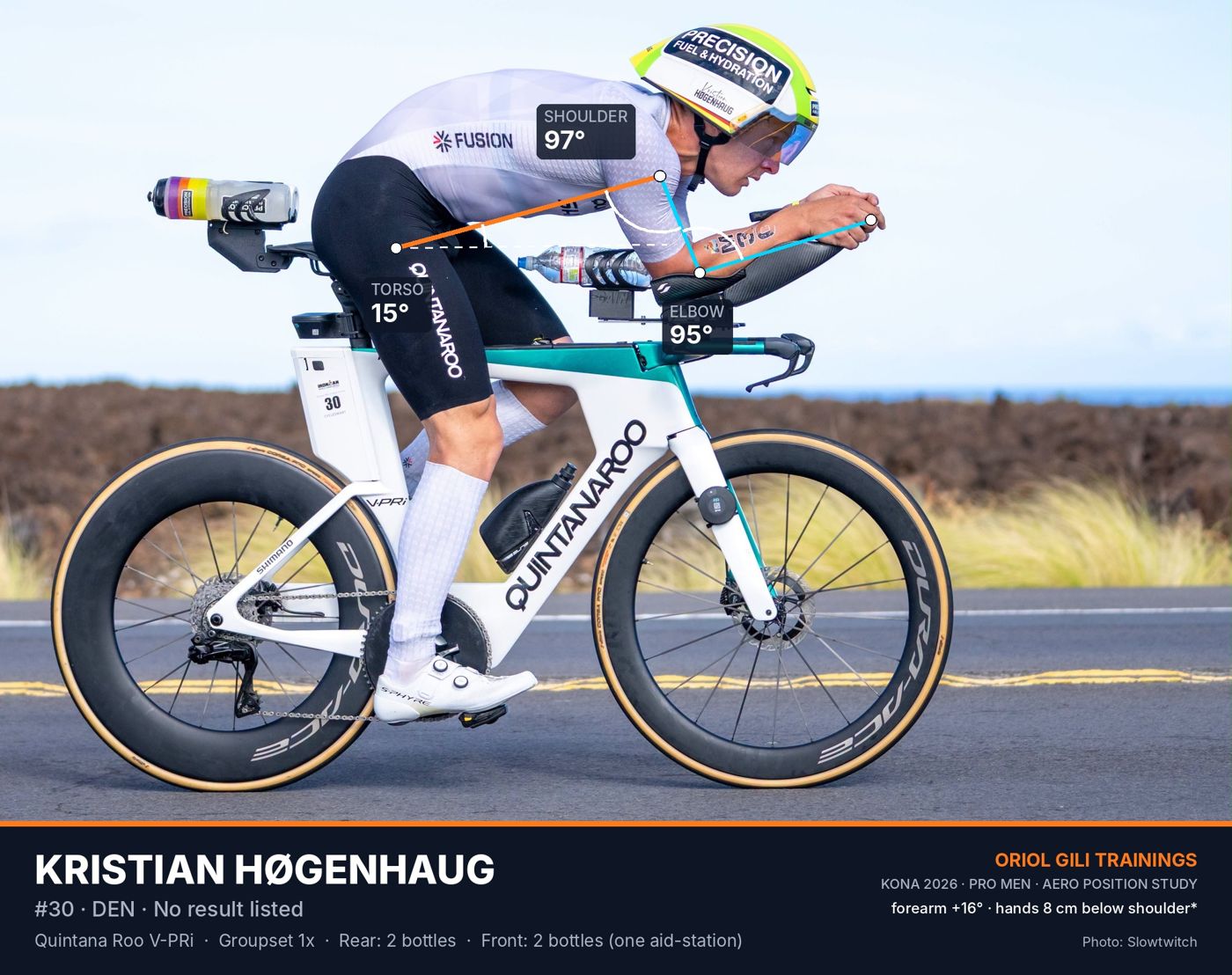
We measured 15 of the pro men’s bikes on the Queen K at the 2026 IRONMAN World Championship in Kona. The surprise is not how low they ride. It is how many of the fastest chose a position they could hold for four hours.
Photos: Slowtwitch. Angles and analysis: Oriol Gili Trainings.
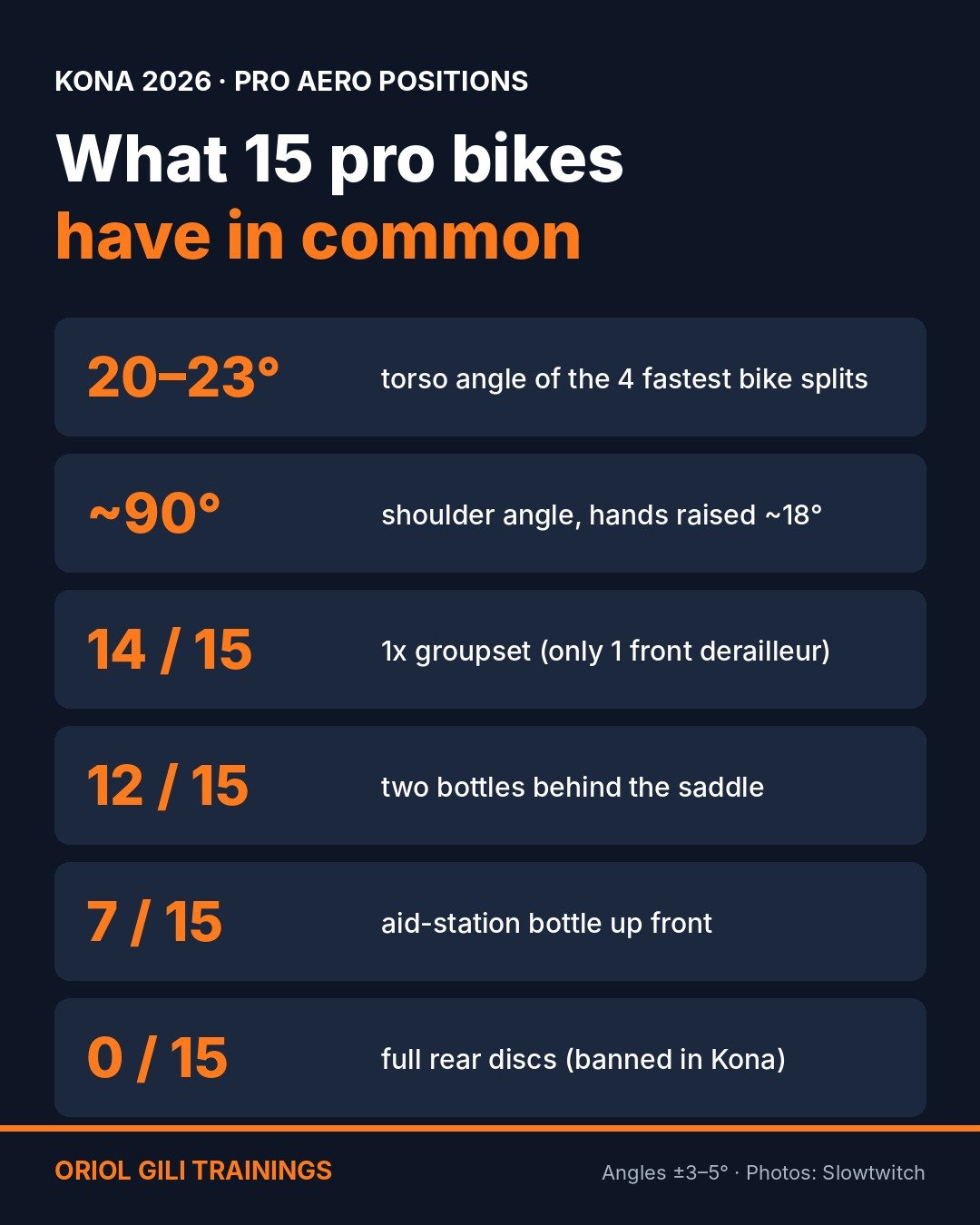
20–23°
Torso angle of the 4 fastest bike splits
14 / 15
Bikes on a 1x groupset
12 / 15
Two bottles behind the saddle
0 / 15
Full rear discs (banned in Kona)
The fastest are not the flattest
The four quickest bike splits in our sample – Gregory Barnaby (4:11:22), Matthew Marquardt (4:11:27), Cameron Wurf (4:12:40) and Sam Long (4:12:49) – all rode with a torso angle between 20° and 23°. The three flattest riders, at 14–16°, finished 27th, did not finish, or have no listed result.
In Kona, the best aero position is the one you can still hold at hour four, in the heat, and then run off.
The 2026 pro position recipe
- Sustainable beats extreme. Median torso 21°, with the fastest splits at 20–23°.
- Shoulders at ~90°. Nobody is stretched long; riders below 85° tuck the arms under the body.
- Hands up. Median forearm tilt 18°, up to 28° for Sam Long. Raised hands shield the head and let the shoulders shrug.
- Head down into the shoulders. The helmet tail touches or nearly touches the back – the helmet only works if the head stays there.
- Hips forward. Everyone sits on the saddle nose with the hip roughly over the bottom bracket.
Kristian Blummenfelt is the outlier: the highest torso of the top finishers (26°) and the most open elbow (111°). He trades frontal area for a compact, powerful stance and still split 4:15.
Every rider, every angle
| Athlete | Result | Bike split | Torso | Shoulder | Elbow | Forearm tilt | Bike | Groupset | Rear bottles |
|---|---|---|---|---|---|---|---|---|---|
| Gustav Iden NOR | 2nd | 4:17:09 | 23° | 89° | 90° | 22° | Giant Trinity | 1x | 1 |
| Matthew Marquardt USA | 3rd | 4:11:27 | 23° | 91° | 94° | 21° | Trek Speed Concept | 1x | 2 |
| Gregory Barnaby ITA | 4th | 4:11:22 | 21° | 89° | 95° | 16° | Pinarello Bolide | 1x | 2 |
| Sam Long USA | 6th | 4:12:49 | 20° | 92° | 84° | 28° | Trek Speed Concept | 1x | 2 |
| Kristian Blummenfelt NOR | 8th | 4:15:05 | 26° | 99° | 111° | 14° | Giant Trinity | 1x | 2 |
| Cameron Wurf AUS | 12th | 4:12:40 | 20° | 82° | 88° | 14° | Pinarello Bolide | 1x | 2 |
| Matt Hanson USA | 20th | 4:36:10 | 30° | 89° | 100° | 18° | Quintana Roo V-PRi | 2x | 2 |
| Ben Kanute USA | 27th | 4:24:40 | 16° | 98° | 98° | 16° | Ventum | 1x | 2 |
| Jason West USA | 29th | 4:26:25 | 24° | 86° | 90° | 21° | Ventum | 1x | 1 |
| Sam Laidlow FRA | DNF | — | 23° | 80° | 92° | 12° | Canyon Speedmax | 1x | 2 |
| Jamie Riddle RSA | DNF | — | 21° | 80° | 84° | 18° | Felt IA | 1x | 2 |
| Patrick Lange GER | DNF | — | 27° | 84° | 90° | 22° | Canyon Speedmax | 1x | 2 |
| Trevor Foley USA | DNF | — | 14° | 88° | 84° | 18° | Felt IA | 1x | 1 |
| Rudy von Berg USA | — | — | 18° | 93° | 95° | 16° | Ventum | 1x | 2 |
| Kristian Høgenhaug DEN | — | — | 15° | 97° | 95° | 16° | Quintana Roo V-PRi | 1x | 2 |
Angles measured by hand on race photos (±3–5°). Results: Tri247. Winner Vincent Luis is not in the photo set.
The kit: 1x, two bottles behind, no discs
- 1x groupsets everywhere. 14 of 15 bikes ran a single chainring, most behind a full carbon cover. Only Matt Hanson used a front derailleur (Shimano Dura-Ace 2x).
- Two bottles behind the saddle. 12 of 15 riders carried two bottles there, where they hide in the rider's own wake.
- Round bottles up front. Most carry a plain round bottle between the arms; a few add a shaped aero bottle or a hose system, and seven had an aid-station bottle tucked in – to drink and to pour over head and arms. Sam Long adds a 3D-printed frame bottle; Cameron Wurf carries a gel flask.
- No discs – by rule. IRONMAN bans solid rear discs in Kona, so riders use spoked wheels that look almost like one (Cadex 4-spoke, Princeton, Scope) or very deep rims.
What age-groupers should copy
Copy the logic, not the numbers. Pros choose kit for 43 km/h and four hours; most age-groupers ride 30–36 km/h for five to seven.
Chainrings: size the ring to your speed
A big ring is about running the chain in the middle of the cassette at race speed, where it is straightest. A pro at 43 km/h on a 60T ring sits around the 15T cog. Here is the cog you need to hold 85 rpm:
| Speed | 48T | 52T | 54T | 56T | 60T |
|---|---|---|---|---|---|
| 20 km/h | 26T | 28T | 29T | 30T | 32T |
| 25 km/h | 21T | 22T | 23T | 24T | 26T |
| 30 km/h | 17T | 19T | 19T | 20T | 21T |
| 35 km/h | 15T | 16T | 17T | 17T | 18T |
| 40 km/h | 13T | 14T | 14T | 15T | 16T |
| 45 km/h | 11T | 12T | 13T | 13T | 14T |
| 50 km/h | 10T | 11T | 12T | 12T | 13T |
Cog needed to hold 85 rpm (700×28c, 2.105 m roll-out). Smallest cog: 10T on SRAM, 11T on Shimano.
- Riding 32–36 km/h on flat courses: a 52–54T single ring with a 10–36 SRAM cassette keeps you mid-cassette and still gives a climbing gear.
- 58–62T rings only make sense if you hold 40 km/h+. They are also hard to buy: commercial rings above 56T are rare, and the 60–62T rings the pros use are mostly custom.
- Why 1x suits pros: they can switch between 1x and 2x from race to race, with a mechanic to reset the chainline each time.
- Hilly courses (Lanzarote, Nice, Mallorca): keep 2x, or check that 1x gives you a gear for 75 rpm on the steepest climb.
Bottles: carry more, not less
You are out one to three hours longer than a pro, so you need more fluid and carbs, not less. Two rear bottles cost almost nothing aerodynamically. Add a cage between the arms that takes both your own and an aid-station bottle, and practise grabbing bottles at speed.
Position: holdable, not flat
A torso of 20–25° is a realistic target for a mobile age-grouper – the fastest pros sit there too. Shoulders at ~90°, hands slightly raised and head tucked cost no power. Get a bike fit, then validate it with long rides in aero at race power.
Wheels: respect the wind
Full discs are banned in Kona but allowed in most age-group races. A lighter rider in crosswinds is better on a 50–65 mm front wheel and a disc or deep rear than on very deep wheels at both ends.
The summary
Want a position you can hold for a full Ironman, and a race setup built for your speed and your course? That is exactly what I work on with the athletes I coach.

Sources
- Photos: Slowtwitch (Facebook post and The Bikes, Wheels, and Gear of the Fastest Riders from Kona 2026)
- Disc rule: Slowtwitch – Either Allow Disc Wheels in Kona or Regulate Wheel Depth
- Results and bike splits: Tri247 – Kona 2026 men's full finishing order
- Bib numbers: Tri247 – Kona 2026 men's start list